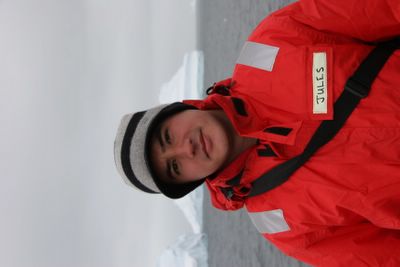
Just a quicky. This is a video I just made. Last night we had an awesome auroral display. It was the bestest ever. I really mean it, I wanted to get naked and dance around. It was trippy. Anyway the video is not finished but it sort of is. I have some fiddling to do and sound to add.
I made it using my digital SLR taking 5s exposures. I then added up the photos and made them into a movie today. Enjoy. I will post the final version soon.
Thursday, May 24, 2007

Sunday, May 13, 2007
Sundown - More Fixing Radars - Starting Mid Winter Presents - Tamsin's Birthday
As usual my blogging plans are never as good as they should be and as usual my blog is way out of date. Everyone else here seems to have the time to blog. I like to think that I am just busier than everyone else. Of course this can't be 100% true. My new plan is to try to at least keep up with what has been happening and then retrospectively catch up on stuff that I missed since the last entry (January). This of course is still likely to fail but I will try my best. So keep looking back because new entries may appear after this one at a later date.
So what has been happening recently? I guess the most significant thing for us is that the sun has gone again. At Halley we have approximately 105 days without the sun. This isn't to say that there is no light, there is alway light. But what does happen is that we don't get to see the actual sun for that time, we just get a glow that appears on the horizon. As is traditional at Halley we have a sundown ceremony where the oldest member of the base lowers the flag. Then in the evening we have a sun related party. Somehow every year there are arguements about when sundown actually is. This is because there are a number of optical instruments here and they all use different definitions of when the sun is actually down. Then of course there is miraging which will can cause the sun to appear above the horizon when it actually isn't. Anyway it is a good excuse for a party.

The laws platform taken whilst walking to lunch just before the sundown ceremony.

A view of the sun at 2pm about 10mins before the flag was lowered.

Chris stands to attention as we wait for everyone to gather on the laws open platform.

Mark and Brian wait at the back. What was really nice on that day was the lovely moon over the Piggott platform.

Jim the Chippy (and the youngest on base, who will be raising the new flag at sun-up) finally makes it. He had a good excuse in that he was on nights but got up specially for the ceremony.

This year it turned out that our Winter Base Commander, Pete, was the oldest on base and had the honour of lowering the flag. He gave us a lovely short speach before the lowering in which he revealed that he would be celebrating his 50th birthday. He did a fine job.

Everyone looked on.
I then wondered back to work this time taking a few photos.

It just amazing the sort of colours you get because of the low sun. The moon as well was awesome.
That day I had to carry on working hard trying to get the new MF radar working again. This radar is located in the optical caboose about 1.5km from the rest of base. Now that winter has really started properly we walk most places because it is more hassle to get a skidoo started and these are all at the garage getting serviced for the next summer. Luckily its a very nice walk (unless you have a load of equipment to drag) especially on a beautiful days.

The view of the base about half way to the optical caboose. The small building in the foreground is the piggot and the larger one in the background is the Laws.
The radar that I have spent a lot of time fixing is the newest radar on base. It has buried antennae. It seems that a lot of my maintenance on this radar is to compensate for the changes in snow properties as it builds up and compacts above the antennae. The properties change and therefore the tuning of the antennae changes. This change is really bad for the radar and we get a lot of energy reflected back into the transmitters. This results in blown up components and overheating.

One of the chips on one of the Power Amplifier cards that has blown up.
These components are all new which means they are all surface mounted. So lately have learnt to desolder surface mounted chips by using gas soldering irons. Its a tiny bit scary, basically using a blow torch to remove components but it actually is less damaging than trying to use a conventional soldering iron.
Hopefully I will have got the MF radar running alot better as I understand it more and more.
I have also been spending a lot of my time making my mid winter present. This is taking up all my spare time but I am starting to believe that it might just work. Not long now either. Mid-winter is less than 6 weeks away so I have to get working. My idea this year is very different from last year and I think one of my problems is that my idea last year was so good. I couldn't do the same thing (it would not be that exciting for me) and so I have gone a little crazy. I hope it will work.
I also realise I haven't been very good at keeping in touch with people this year. So from now on I will be making more of an effort to write my blog and also get back in contact with other people. Give me a call if you know my number.
So what has been happening recently? I guess the most significant thing for us is that the sun has gone again. At Halley we have approximately 105 days without the sun. This isn't to say that there is no light, there is alway light. But what does happen is that we don't get to see the actual sun for that time, we just get a glow that appears on the horizon. As is traditional at Halley we have a sundown ceremony where the oldest member of the base lowers the flag. Then in the evening we have a sun related party. Somehow every year there are arguements about when sundown actually is. This is because there are a number of optical instruments here and they all use different definitions of when the sun is actually down. Then of course there is miraging which will can cause the sun to appear above the horizon when it actually isn't. Anyway it is a good excuse for a party.

The laws platform taken whilst walking to lunch just before the sundown ceremony.

A view of the sun at 2pm about 10mins before the flag was lowered.

Chris stands to attention as we wait for everyone to gather on the laws open platform.

Mark and Brian wait at the back. What was really nice on that day was the lovely moon over the Piggott platform.

Jim the Chippy (and the youngest on base, who will be raising the new flag at sun-up) finally makes it. He had a good excuse in that he was on nights but got up specially for the ceremony.

This year it turned out that our Winter Base Commander, Pete, was the oldest on base and had the honour of lowering the flag. He gave us a lovely short speach before the lowering in which he revealed that he would be celebrating his 50th birthday. He did a fine job.

Everyone looked on.
I then wondered back to work this time taking a few photos.

It just amazing the sort of colours you get because of the low sun. The moon as well was awesome.
That day I had to carry on working hard trying to get the new MF radar working again. This radar is located in the optical caboose about 1.5km from the rest of base. Now that winter has really started properly we walk most places because it is more hassle to get a skidoo started and these are all at the garage getting serviced for the next summer. Luckily its a very nice walk (unless you have a load of equipment to drag) especially on a beautiful days.

The view of the base about half way to the optical caboose. The small building in the foreground is the piggot and the larger one in the background is the Laws.
The radar that I have spent a lot of time fixing is the newest radar on base. It has buried antennae. It seems that a lot of my maintenance on this radar is to compensate for the changes in snow properties as it builds up and compacts above the antennae. The properties change and therefore the tuning of the antennae changes. This change is really bad for the radar and we get a lot of energy reflected back into the transmitters. This results in blown up components and overheating.

One of the chips on one of the Power Amplifier cards that has blown up.
These components are all new which means they are all surface mounted. So lately have learnt to desolder surface mounted chips by using gas soldering irons. Its a tiny bit scary, basically using a blow torch to remove components but it actually is less damaging than trying to use a conventional soldering iron.
Hopefully I will have got the MF radar running alot better as I understand it more and more.
I have also been spending a lot of my time making my mid winter present. This is taking up all my spare time but I am starting to believe that it might just work. Not long now either. Mid-winter is less than 6 weeks away so I have to get working. My idea this year is very different from last year and I think one of my problems is that my idea last year was so good. I couldn't do the same thing (it would not be that exciting for me) and so I have gone a little crazy. I hope it will work.
I also realise I haven't been very good at keeping in touch with people this year. So from now on I will be making more of an effort to write my blog and also get back in contact with other people. Give me a call if you know my number.
Tuesday, April 10, 2007
January - At last
Sorry once again for being so rubbish at keeping my blog updated. It seems that I have either been too busy and maybe a bit too lazy.
One other mishap that happened was that the hard drive on my laptop decided to kill itself. One second it was fine and the next it was making those "knock knock you know what has happened" noises. So I have spent the last week rebuilding my computer. Luckily I had a small external hard drive. I took everything off this and then sacrificed it to the laptop gods and now it is living as the laptop hard drive. I still don't know quite what I have lost but I will slowly discover it I am sure.
What is certain is that I now have no excuses for not updating the blog. Of course now I can't remember what the dickens happened in January but I will give it a try. I also had the honour of writing the base Web Diary which was not really up to the normal standard. So if I am repeating what I talked about in the web diary you must forgive me.
Unlike last year, when relief finished by New Years Eve, this year the madness started on New Year’s Day. After a week of the ship being stuck 50 miles from N9 in heavy sea-ice and everyone on base on standby for relief, it was a relief when the wind changed direction and the ship eased its way to N9. N9 is the site that we used last year which is 59km to the north-east of Halley and is used because there always seems to be either good sea ice or if that has disappeared then there is low shelf ice. There is low shelf ice there because there is a massive crack there that runs for about 100km all the way to the hinge zone. N9 was chosen, as there was too much sea-ice at the creeks this year, once again very different from last year when it was chosen because there was too little ice at the creeks. This meant that we had to prepare ourselves for the long drive there (max speed of a snocat pulling a sledge is about 15kph). For some strange reason I was the only winterer to be assigned to work shipside for relief. It was very exciting not to be on base but at the same time I was so used to being around a small bunch of winterers that not being with them was very odd. There was a good carnival atmosphere as we drove to the ship just because we were going to see loads of other people.

One other mishap that happened was that the hard drive on my laptop decided to kill itself. One second it was fine and the next it was making those "knock knock you know what has happened" noises. So I have spent the last week rebuilding my computer. Luckily I had a small external hard drive. I took everything off this and then sacrificed it to the laptop gods and now it is living as the laptop hard drive. I still don't know quite what I have lost but I will slowly discover it I am sure.
What is certain is that I now have no excuses for not updating the blog. Of course now I can't remember what the dickens happened in January but I will give it a try. I also had the honour of writing the base Web Diary which was not really up to the normal standard. So if I am repeating what I talked about in the web diary you must forgive me.
Unlike last year, when relief finished by New Years Eve, this year the madness started on New Year’s Day. After a week of the ship being stuck 50 miles from N9 in heavy sea-ice and everyone on base on standby for relief, it was a relief when the wind changed direction and the ship eased its way to N9. N9 is the site that we used last year which is 59km to the north-east of Halley and is used because there always seems to be either good sea ice or if that has disappeared then there is low shelf ice. There is low shelf ice there because there is a massive crack there that runs for about 100km all the way to the hinge zone. N9 was chosen, as there was too much sea-ice at the creeks this year, once again very different from last year when it was chosen because there was too little ice at the creeks. This meant that we had to prepare ourselves for the long drive there (max speed of a snocat pulling a sledge is about 15kph). For some strange reason I was the only winterer to be assigned to work shipside for relief. It was very exciting not to be on base but at the same time I was so used to being around a small bunch of winterers that not being with them was very odd. There was a good carnival atmosphere as we drove to the ship just because we were going to see loads of other people.

Our first view of the ship as we approached N9. The twin otter plane is on the left.
As usual everyone was split into day or night shifts so that relief continued 24 hours a day. I happened to be on night shift which I can now say is not as good as day shift. It is summer so we have 24 hour daylight but its still colder on night shift. Having woken up early in the morning to drive the snocats to the ship, I found out that the next night shift was when relief started. We ate some lovely salad on the ship and I tried to get some sleep. Of I couldn't really. We then started our shift and drove a number of people and some sledges to the halfway point. It then turned out that the snocat from the Halley end, that we were supposed to meet halfway, hadn't even left. So we stayed in the halfway caboose and played scrabble. It was a pretty tiring day and after that relief just sort of blended into a blur of driving in poor contrast and then helping loading beside the ship on the ice.
As usual everyone was split into day or night shifts so that relief continued 24 hours a day. I happened to be on night shift which I can now say is not as good as day shift. It is summer so we have 24 hour daylight but its still colder on night shift. Having woken up early in the morning to drive the snocats to the ship, I found out that the next night shift was when relief started. We ate some lovely salad on the ship and I tried to get some sleep. Of I couldn't really. We then started our shift and drove a number of people and some sledges to the halfway point. It then turned out that the snocat from the Halley end, that we were supposed to meet halfway, hadn't even left. So we stayed in the halfway caboose and played scrabble. It was a pretty tiring day and after that relief just sort of blended into a blur of driving in poor contrast and then helping loading beside the ship on the ice.
This year saw the arrival of some new vehicles: 2 Challengers and 2 John Dere tractors. However to begin with the snocats took the brunt of the work load.

Jim the new wintering Chippie who was my driving buddy filling the transit tanks with avtur from the ship. The big green tractor is a John Dere with a track kit.

The new Challenger showing that it can do the job of three snocats.
As the new vehicles came on line the snocats were slowly retired until only the new vehicles were running. The weather was not nice either for a few days and this slowed down many of the shifts. There wasn’t that much wildlife this time at the ship except for a trio of Adelies that kept on turning up.

During relief the first few 2007 winterers arrived at their new home for the next year. Hopefully they weren’t too shocked. Even with the bad weather and only four vehicles performing the relief, the fact that they could all pull a lot more than the snocats meant the relief was over in a week.

Finally everyone arrived on station and we could all get back on days and get on with the summer season.

This year the major changes to the base seem to be the moving of the Garage and the Drewry buildings closer to the Laws. As well as that there is more Halley 6 sledge testing and a garage refurbishment. This is on top of the usual caboose, tunnel entrance raises and usual summer maintenance. On the science side we are installing a number of new instruments, lots at the CasLab, a new MF radar, and the flying of Unmanned Autonomous Vehicles (UAVs).
One of the experiments used scale models of the Laws platforms and models of the new Halley 6 buildings to investigate the wind tail profiles that may form at the new
Base.

Simon measures the snow accumulation around the model of the Laws platform.

Looking at the snow levels around the new Halley 6 modules.
All this adds up to a very busy summer especially when you consider that the summer season is less than 6 weeks long.
The aircraft was very busy, firstly carrying out the servicing of remote science equipment on the continent towards the pole. Later it was being used to remove empty drums from some of the field sites close by.

Alex services the instruments at A84.

Drum loading at Site 5.
Somehow the new faces seem to have boundless energy (maybe we did last year) and are out every night skijouring, kiting or x-country skiing depending on the wind.


Jim the new wintering Chippie who was my driving buddy filling the transit tanks with avtur from the ship. The big green tractor is a John Dere with a track kit.

The new Challenger showing that it can do the job of three snocats.
As the new vehicles came on line the snocats were slowly retired until only the new vehicles were running. The weather was not nice either for a few days and this slowed down many of the shifts. There wasn’t that much wildlife this time at the ship except for a trio of Adelies that kept on turning up.

During relief the first few 2007 winterers arrived at their new home for the next year. Hopefully they weren’t too shocked. Even with the bad weather and only four vehicles performing the relief, the fact that they could all pull a lot more than the snocats meant the relief was over in a week.

Finally everyone arrived on station and we could all get back on days and get on with the summer season.

This year the major changes to the base seem to be the moving of the Garage and the Drewry buildings closer to the Laws. As well as that there is more Halley 6 sledge testing and a garage refurbishment. This is on top of the usual caboose, tunnel entrance raises and usual summer maintenance. On the science side we are installing a number of new instruments, lots at the CasLab, a new MF radar, and the flying of Unmanned Autonomous Vehicles (UAVs).
One of the experiments used scale models of the Laws platforms and models of the new Halley 6 buildings to investigate the wind tail profiles that may form at the new
Base.

Simon measures the snow accumulation around the model of the Laws platform.

Looking at the snow levels around the new Halley 6 modules.
All this adds up to a very busy summer especially when you consider that the summer season is less than 6 weeks long.
The aircraft was very busy, firstly carrying out the servicing of remote science equipment on the continent towards the pole. Later it was being used to remove empty drums from some of the field sites close by.

Alex services the instruments at A84.

Drum loading at Site 5.
Somehow the new faces seem to have boundless energy (maybe we did last year) and are out every night skijouring, kiting or x-country skiing depending on the wind.

Judgie showing his skills just before he took a bad fall and hurt himself.


So many kites and so many good kiters. I thought my skills and a year down here would allow me to show off but all the newbies are naturals. Its just so unfair.
As usual there was the summer football match, with no injuries for a change.


What you see there is me on the floor having just been pushed over by John (ex Winter BC and fouler) who has the ball.
Sunday, February 25, 2007
Catchup 2: A brief journey through January
Will add pictures etc... from January, but here is a little video from one of my summer jobs which was to move the search coil magnetometer from one of the cabooses to the Simpson platform. The sensors (coils) were buried in the snow in a 1150mm x 1150mm x 1150mm box that I built. I made the movie using my digital camera set to take photos every 6 seconds and then compiled the photos into this.
The other person helping me is Simon Coggins ex Halley Winterer and current Science coordinator.
One of the other things that I have done is cut off my beard. As some of you know I have been growing a pretty disgusting beard since Sci-fi night and have tried to take a photo of myself every night. Here is the result.
The other person helping me is Simon Coggins ex Halley Winterer and current Science coordinator.
One of the other things that I have done is cut off my beard. As some of you know I have been growing a pretty disgusting beard since Sci-fi night and have tried to take a photo of myself every night. Here is the result.
Friday, February 23, 2007
Catchup 1: A brief journey through December
Looking back at my blog I can see that I have a lot of work to do to catch up with what has happened in the last few months. This is the first attempt that I have made since the beginning of december and as usual the reason for not being able to write the blog has been that I have been amazingly busy. As usual my nights haven't been enough to catch up on everything. But hopefully this is a start. At the end of the last entry I mentioned that a second Basler aircraft flew in and with spares etc... in order to fix the broken plane. That plane disappeared and we resumed our time digging up things burind in the snow and raising them in preparation for the summer.
For me, as mast officer, this involved a lot of raising turnbuckles as the snow just keeps on falling here.

Dave the Comms manager struggles to get a chicago grip attached to the stay. You essentially use two chicago grips and a chain hoist to take the strain off of the turnbuckle so that you can shorten the turnbuckle and add in a 1.5m strop. This then raises the turnbuckle about 1m off the ground. Nearly all the turnbuckles on the comms masts had to be raised this year.

Once they were all raised we then used a theodolite to carry out a mast survey. This allows the RAF summer masties to come in and decide what work needs to be done.
One of the new things that we have done is to start ice carving. We had some blocks of ice and a few old chisels from Liz the chippie and just started to chip away. As expected we immediately started to carve penguins. Then Fran came out and started to carve a snocat. (These carvings were never completely finished and just before relief, Kirsty and I took them to the Maggy shaft where the temperature hovers around -10 degrees C for safe keeping. Hopefully we will finish them off and I will get some good photos to show you)

Kirsty and Fran show off their carving on the Laws south platform. The most surprising thing is how soft the ice is when you have a sharp chisel to use. It just cuts like some sort of plastic. I thought it would be really hard and tough. You can do very detailed work.
One of the other things we have to raise is the catenaries. The catenaries are what we call the cable runs to the antennae. These cables hang on large fence posts.

Here John shows how low a catenary can get. When these are raised they are about 8 foot above the snow surface.
With the expected coming of summer we also had our final winter party. Its all a bit sad that we are saying goodbye to so many people. And after a year we really got used to each other and made some amazing friends. Of course six of us were staying which was good. We have also had a year of samba playing with our drum guru Dave (Band Name: Drum line) and the Halley band had also been practicing for at least 6 months. This was our last opportunity to show off to each other. Another interesting contruction was the making of Vodka luge. This massive block of ice was made by taking a bucket of water and leaving in outside.

Fran samples the vodka.

The Halley band run through their greatest hits.

For me, as mast officer, this involved a lot of raising turnbuckles as the snow just keeps on falling here.

Dave the Comms manager struggles to get a chicago grip attached to the stay. You essentially use two chicago grips and a chain hoist to take the strain off of the turnbuckle so that you can shorten the turnbuckle and add in a 1.5m strop. This then raises the turnbuckle about 1m off the ground. Nearly all the turnbuckles on the comms masts had to be raised this year.

Once they were all raised we then used a theodolite to carry out a mast survey. This allows the RAF summer masties to come in and decide what work needs to be done.
One of the new things that we have done is to start ice carving. We had some blocks of ice and a few old chisels from Liz the chippie and just started to chip away. As expected we immediately started to carve penguins. Then Fran came out and started to carve a snocat. (These carvings were never completely finished and just before relief, Kirsty and I took them to the Maggy shaft where the temperature hovers around -10 degrees C for safe keeping. Hopefully we will finish them off and I will get some good photos to show you)

Kirsty and Fran show off their carving on the Laws south platform. The most surprising thing is how soft the ice is when you have a sharp chisel to use. It just cuts like some sort of plastic. I thought it would be really hard and tough. You can do very detailed work.
One of the other things we have to raise is the catenaries. The catenaries are what we call the cable runs to the antennae. These cables hang on large fence posts.

Here John shows how low a catenary can get. When these are raised they are about 8 foot above the snow surface.
With the expected coming of summer we also had our final winter party. Its all a bit sad that we are saying goodbye to so many people. And after a year we really got used to each other and made some amazing friends. Of course six of us were staying which was good. We have also had a year of samba playing with our drum guru Dave (Band Name: Drum line) and the Halley band had also been practicing for at least 6 months. This was our last opportunity to show off to each other. Another interesting contruction was the making of Vodka luge. This massive block of ice was made by taking a bucket of water and leaving in outside.

Fran samples the vodka.

The Halley band run through their greatest hits.

Me playing the surdu with Drum line.
One of the more interesting raising jobs was the raising of the Halley 6 Automatic Weather Station (AWS). This AWS is sitting at the site of the new base and is about 15km away from Halley 5. One of the interesting things here is the accumulation at the site. There seems to be more accumulation here that nearly anywhere else I have seen.
On arrival at the site we realise that the accumlation has been so large that the solar panels are no longer available and that there is going to be a lot of digging to do. Chris shows how low the sensors are. Luckily it is a wonderful day weatherwise and its a lot of fun. I feel sorry for the Halley 6 winterers if this is the accumulation they are going to get every year.

Liz shows that you can read Cosmo anywhere during one of her breaks.

Digging seems to be all we do here before summer. As you can see the weather was really great which meant that we were digging and sweating in our t-shirts. We excavated a massive hole in order to get the wires and batteries up to the surface again.
The raising team after we had got everything out. Reading from left to right we have Andy, Chris, Liz, Kirsty (team leader) and me. We actually moved the Halley 6 site 5m closer to Halley 5 as the AWS is the only thing that marks the new site.
During this time we had the damaged Basler repaired and then flown out via us. So once again we saw the canadian pilots. We finally also had the Germans fly through with their Dornier 228. They returned a few days later with Pat the Summer BC, Martin and Ben (Vehicle Division) in order to prepare for the arrival of the ship. We also had the BAS twin otter arrive from Rothera. On board was the head of my division Mike Pinnock and Mark Maltby one of the Rothera Electronic Engineers who came over to help install a new medium frequency (MF) radar. This was to be one of my summer projects, that is to install the MF radar.
The ship then got stuck in heavy sea ice and couldn't make its way through. Luckily for us this meant that we could have one more penguin trip. I like to think I had something to do with persuading Simon to organise the trip as I was the main person bugging him to do it.
This also allowed the some of the summer people to get to see the penguins, which is something they rarely get to do. One of the crazy things on this trip to windy cove was that when we got there, there were juvenile penguins actually on the ice-shelf. These curious little fellows had climbed up the slope right to the top. It was true that the slope had become shallower, but even so it was impressive.
Anto and Ian the pilot snap away at the penguins at the top of the slope.

From the top we could see that the whole colony had dispersed. There were still loads of them but they were completely spread out. Very different from the two other times I had come. 
I also caught this adult going to the loo.

It was a pretty amazing evening, to be down on the sea-ice in only -5 degrees with sun dogs and penguins. It just reminded me how luckly I am to be here.

As usual the adults looked well groomed.
The adults are now the less flighty birds. And the chicks that used to be so curious and who used to wander right up to you are very very flighty. Here a returning mother wanders over to me.

The chicks are also nearly as large as the parents. I much prefer them when they were tiny little things what were cute instead of the big ugly scardy cats that they are now. They are also starting to loose their feathers and so they look even worse.

Fran walks underneath the chicks that made it to the top.

Some chicks hanging out under a cornice that is starting to thaw.
The trip to the penguins was amazing as usual. The ship was stuck in ice until new years eve when the wind finally changed and blew some of the ice out of the way. On base we had a subdued new year's celebration. As we knew that relief would happen the next day. At least we had a good christmas dinner and party where we played the samba drums again. The ship ended up being 8 days late which meant that the summer season was shorter and therefor busier. But that is another story for another entry. Hopefully will get an entry for January in very soon.
Thursday, February 15, 2007
Still Alive
Just thought I would make a quick post as I am just about to go on nights and in the next week should have enough time to catch up on the blogging side of things. The ship has come for second call. Which means that summer is nearly over and all the summerers will have left us in the next two days. Over half of them have left already and are staying on the ship. All us winterers got to go to the ship and have our teeth checked by the dentist. After that there is only one last plane (the Basler) on its way out of Antarctica to go and then we shall have our 10 months alone again.

Watch this space because I will be blogging to try to catch up all that has happened.

Watch this space because I will be blogging to try to catch up all that has happened.
Friday, February 02, 2007
Alive.
Hi. Long time no post. Have been busy working which is good and playing which is also very good. I will finish off and update this blog very soon as I am now getting myself more organised. There is a bit of news I guess and that is I am going to be the deputy winter base commander. I am not quite sure what this involves but it should be interesting.
I am also writing the january webdiary for the base.
I am also writing the january webdiary for the base.
Sunday, December 03, 2006
Whats been happening for the last Month? - Planes - Cranes and Getting ready for the Summer
So its been ages since I last posted and the main reason for that is that there has been too much happening. Now that its getting a lot warmer it means that we can go out and do a lot more outdoor work. Another thing that has happened is that the CAA (Civil Aviation Authority) in the Uk delayed the BAS planes for some reason (something to do with cargo weights and the stength of the wheel skis that they use) that I'm not really sure about. They are coming but later than expected. This means that new people (Pat the base commander and Ben and Martin (vehicle guys)) won't be coming in so early. The RRS Ernest Shackleton is also required somewhere else in the North earlier than usual which means that this summer season is going to be shorter than normal. So we are being urged to get as much work done as possible.
One of the people put under a lot more pressure because of the delayed planes is Anto the vehicle mech who has to prepare all the vehicles for relief on his own. So some of us have been giving him a hand and learning to drive some of the vehicles around a bit more. I seem to have become an expert at dozer driving.
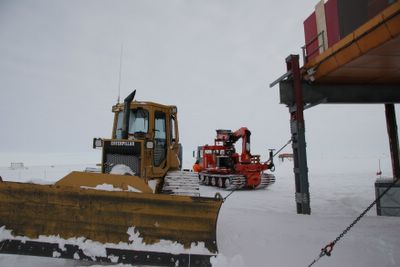
Picture of the D4 dozer that I drove for a day helping Anto the vehicle mech move stuff around. In the background you can see the Nodwell crane parked by the Laws platform. We were transfering propane gas stillages up the the platform and getting rid of the empty ones. That day I think I worked until 11pm.
The other thing that has happened is that the skiway has been laid down. On a bearing from the 4km marker that we raised the other day. And the first planes have been through. The first was a Basler which is essentially a DC 3 that has had turbo props added instead of the usual piston engines and its also slightly stretched at the front. This plane came through nearly a month ago bringing with it fresh veg and new people.

The Basler being refueled. This is actually the 2nd Basler, I didn't make it down to the skiway either time but Vicki the Doc took my camera when the 2nd plane came in.
The plane dropped off its food, refueled and headed off the the Shackletons (mountain range) and then Novolazarevskaya or Novo as most people call it. A few days later we heard that the plane had crashed. We were not allowed to tell anyone for a bit as they hadn't informed next of kin etc... No one was injured and a search and rescue (SAR) was launched. The SAR plane came from Patriot Hills and flew through Halley. The SAR plane turned out to be a twin otter just like the BAS planes.

The Twin Otter from Patriot Hills as it approached Halley.
I did make it down to the skiway this time and even though we knew that the plane was here for a SAR there was a bit of a buzz as we were going to see new people. It was a lovely day and we spotted the plane a long way away. When it came close we started to hear the UHF radio talk between Dave the comms manager and the pilot. So you can picture the reaction from some of the men at the skiway when we heard the female voice of one of the pilots. Some of them (not me of course) suddenly became all shy and started grooming their beards. Of course this was understandable since they hadn't seen a different lady for a long while. Not that you would call any of the ones on base ladies anyway (only joking).

The Twin Otter, taxiing in. This plane is pretty much exactly the same as the BAS ones except that they have full skis instead of the wheel skis that BAS favours.
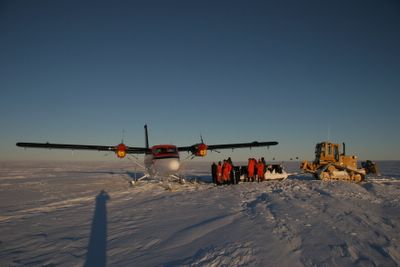
The plane being refuelled at about 10pm, although it is 24 hour daylight the shadows can still get very long late at night.
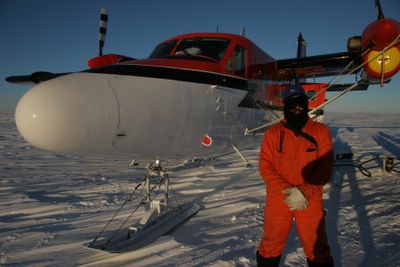
Me (don't I look dashing) standing next to the nose ski of the plane. You can see how robust the ski landing gear looks. They are alot stronger that the wheel skis that BAS use but then again you can't land on gravel runways with skis.
The crew of the plane, had a leisurely dinner and didn't seem in too much of a rush for a SAR but that might have been due to slow communications with some of the other bases. They seemed to enjoy the base and I don't think we scared them too much. At one point, whilst Brad the mechanic was eating dinner, however, about half the base was sat at the other end of the table asking questions. We were probably staring because we haven't seen new people for a long time. We then helped them refuel.

Amy the copilot (who caused quite a stir with some of the men on base) checking the fuel levels in the two massive ferry tanks that they had fitted in the back of the plane.

The plane heading off finally heading off to resue the people on the other plane.
The next day after the twin otter left, despite it being a saturday we spent the whole afternoon drum raising. These drums were 44 gallon (205 litre) drums of Avtur (aviation fuel) which nearly everything down here runs on. They are piled in to heaps of 200ish drums and you have to use the Nodwell crane to hoik them out of the snow. Once they are out of the snow they are dropped onto sledges and flipped upright by hand. Thankfully I didn't have to do too much digging or flipping as I was the designated dozer driver for my shifts.
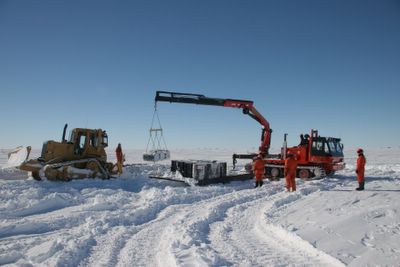
Raising drums of avtur out of the ground and loading them onto sledges.
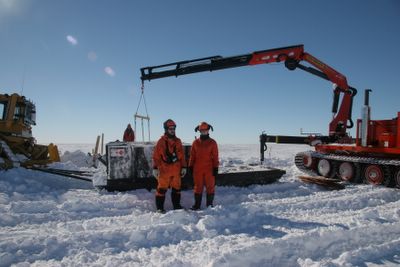
Me and Kirsty just before we did our double shift (I think because Anto thinks I am such a good dozer driver).
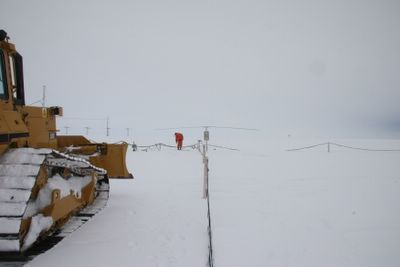
More raising, this time its the AIS receiver antennae. Because of the snow accumulation we had to raise them 2m. As you can see

Once they are lowered to the ground, we checked that they were ok. We attached a new bit of scaffold of then craned them back up and slotted them on.
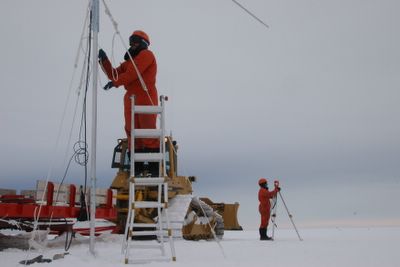
Me tidying up the cables whilst Liz sets up the theodolite in the background so that the poles are vertical.
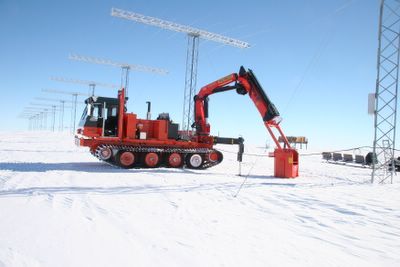
Nod 4 with the basket attached. This allows us to lift 250kgs to a height much more than a cherry picker, but relies on the man on the ground to safely move us around.
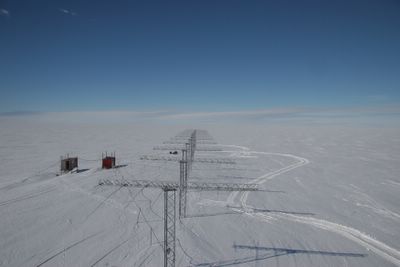
The view of the SHARE array from way above tower number 4. This is from the basket at full extension and being on a flat ice shelf its really odd to look down on anything, especially these antennae.
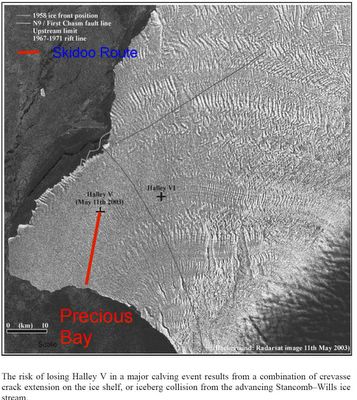
Precious Bay is the bay to the south west of Halley and it is this sea ice that is thought to break up and reform causing ODEs (Ozone Depletion Events). The ODEs trigger sensors and Halley and then the Simpson team launch their Blimp to get a profile of the ozone.
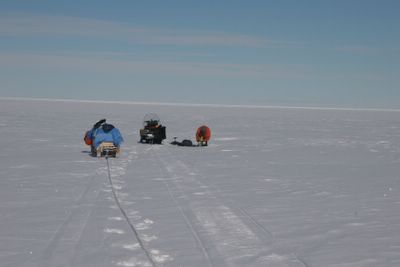
Simon putting on his crampons before our walk down to the ice cliff edge of Precious bay.

Me near the edge at the bay. Photo courtesy of Simon the GA.
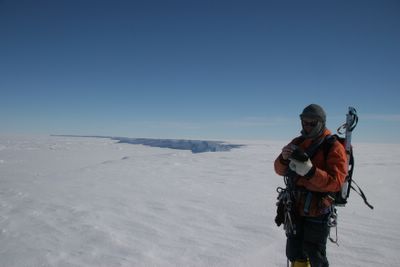
Simon the GA checking out the magnificant view. It was amazingly beautiful with this massive bay and the sea ice stretched out unbroken for miles ahead of us.
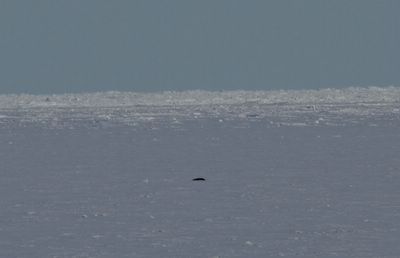
Right out on the iceshelf we saw this black dot probably 2km from us and all we could tell was that it was an animal. I put on my big lens (70-300mm) and zoomed in as much as I could. The above picture is cropped and you can make out that it is definetly a seal. So given the state of the ice its probably a Weddell seal (they are the only ones to keep open holes in the ice) but it could have been a leopard seal that had travelled a bit on the ice. From the distance we were away it was just life.

Me next to a marked flag planted at the Precious Bay experiment site that should tell us about snow accumulation.

More raising, this time it was the catenary posts that hold up the wires the antennae. You take of the wires then get a dozer and use the a chain attached to the blade to pull the posts out of the ground.

Chris posing after we had put all the posts back in the ground in their raised positions.

And finally the catenaries are back up.

The Basler again. Its a fantastic plane. You can see the person on the wing (Francis I think) who is holding the fuel pipe that is pumping fuel into the wing tanks.
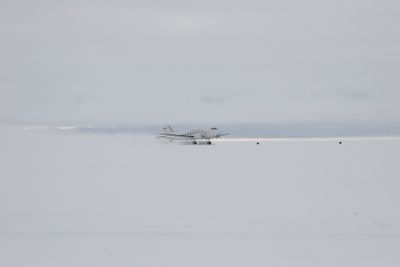
The plane heading off to Novo to move people around and to resue its sister plane nearby.
One of the people put under a lot more pressure because of the delayed planes is Anto the vehicle mech who has to prepare all the vehicles for relief on his own. So some of us have been giving him a hand and learning to drive some of the vehicles around a bit more. I seem to have become an expert at dozer driving.
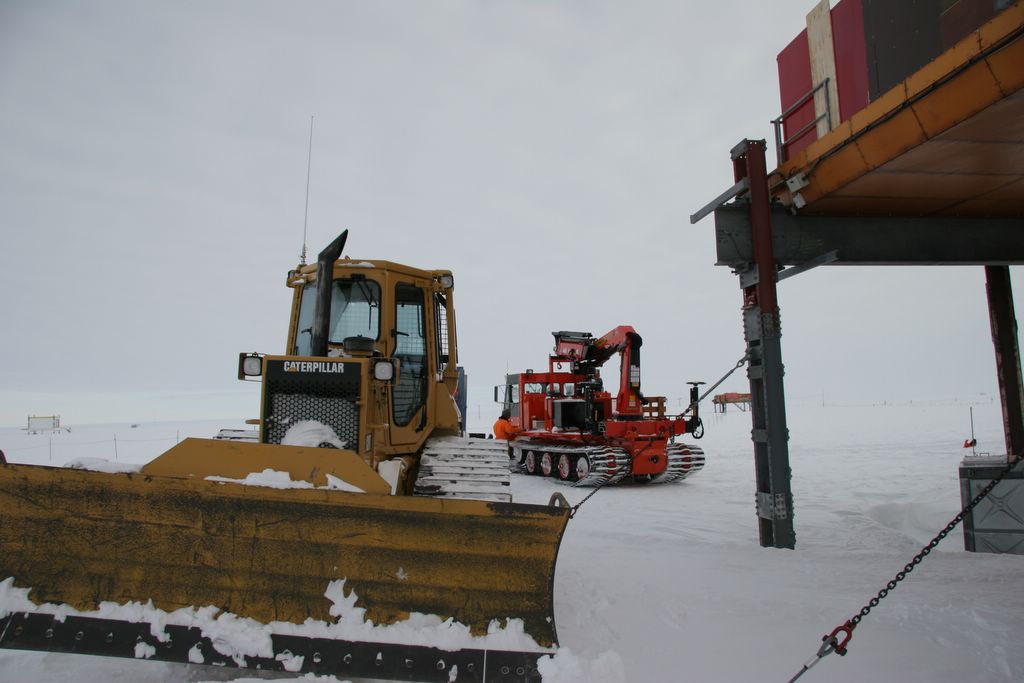
Picture of the D4 dozer that I drove for a day helping Anto the vehicle mech move stuff around. In the background you can see the Nodwell crane parked by the Laws platform. We were transfering propane gas stillages up the the platform and getting rid of the empty ones. That day I think I worked until 11pm.

The other thing that has happened is that the skiway has been laid down. On a bearing from the 4km marker that we raised the other day. And the first planes have been through. The first was a Basler which is essentially a DC 3 that has had turbo props added instead of the usual piston engines and its also slightly stretched at the front. This plane came through nearly a month ago bringing with it fresh veg and new people.

The Basler being refueled. This is actually the 2nd Basler, I didn't make it down to the skiway either time but Vicki the Doc took my camera when the 2nd plane came in.
The plane dropped off its food, refueled and headed off the the Shackletons (mountain range) and then Novolazarevskaya or Novo as most people call it. A few days later we heard that the plane had crashed. We were not allowed to tell anyone for a bit as they hadn't informed next of kin etc... No one was injured and a search and rescue (SAR) was launched. The SAR plane came from Patriot Hills and flew through Halley. The SAR plane turned out to be a twin otter just like the BAS planes.

The Twin Otter from Patriot Hills as it approached Halley.
I did make it down to the skiway this time and even though we knew that the plane was here for a SAR there was a bit of a buzz as we were going to see new people. It was a lovely day and we spotted the plane a long way away. When it came close we started to hear the UHF radio talk between Dave the comms manager and the pilot. So you can picture the reaction from some of the men at the skiway when we heard the female voice of one of the pilots. Some of them (not me of course) suddenly became all shy and started grooming their beards. Of course this was understandable since they hadn't seen a different lady for a long while. Not that you would call any of the ones on base ladies anyway (only joking).

The Twin Otter, taxiing in. This plane is pretty much exactly the same as the BAS ones except that they have full skis instead of the wheel skis that BAS favours.
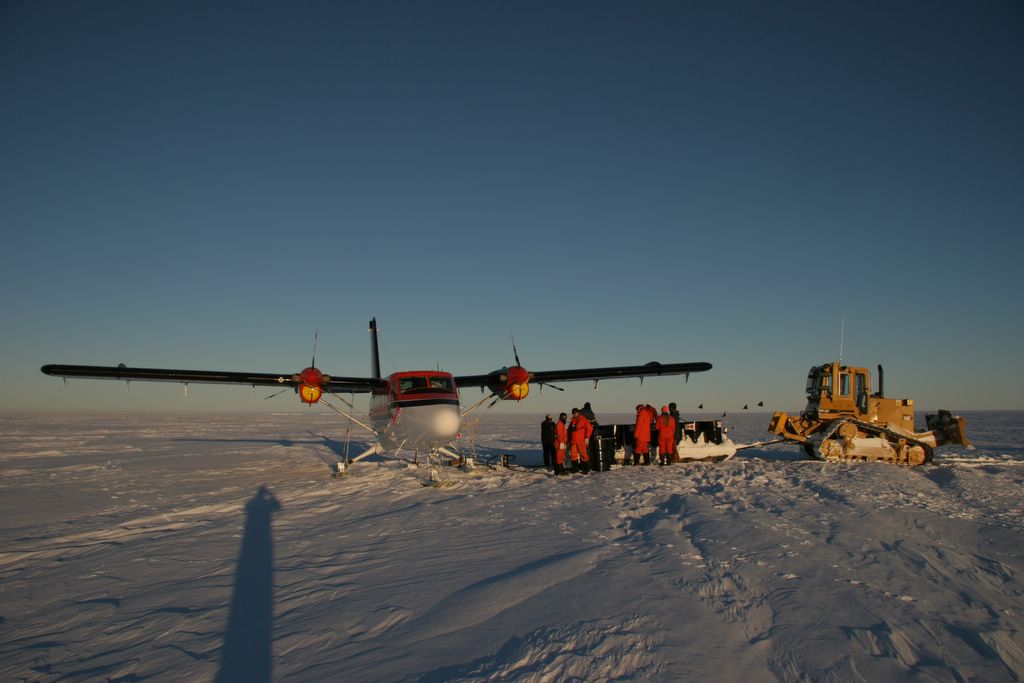
The plane being refuelled at about 10pm, although it is 24 hour daylight the shadows can still get very long late at night.

Me (don't I look dashing) standing next to the nose ski of the plane. You can see how robust the ski landing gear looks. They are alot stronger that the wheel skis that BAS use but then again you can't land on gravel runways with skis.
The crew of the plane, had a leisurely dinner and didn't seem in too much of a rush for a SAR but that might have been due to slow communications with some of the other bases. They seemed to enjoy the base and I don't think we scared them too much. At one point, whilst Brad the mechanic was eating dinner, however, about half the base was sat at the other end of the table asking questions. We were probably staring because we haven't seen new people for a long time. We then helped them refuel.
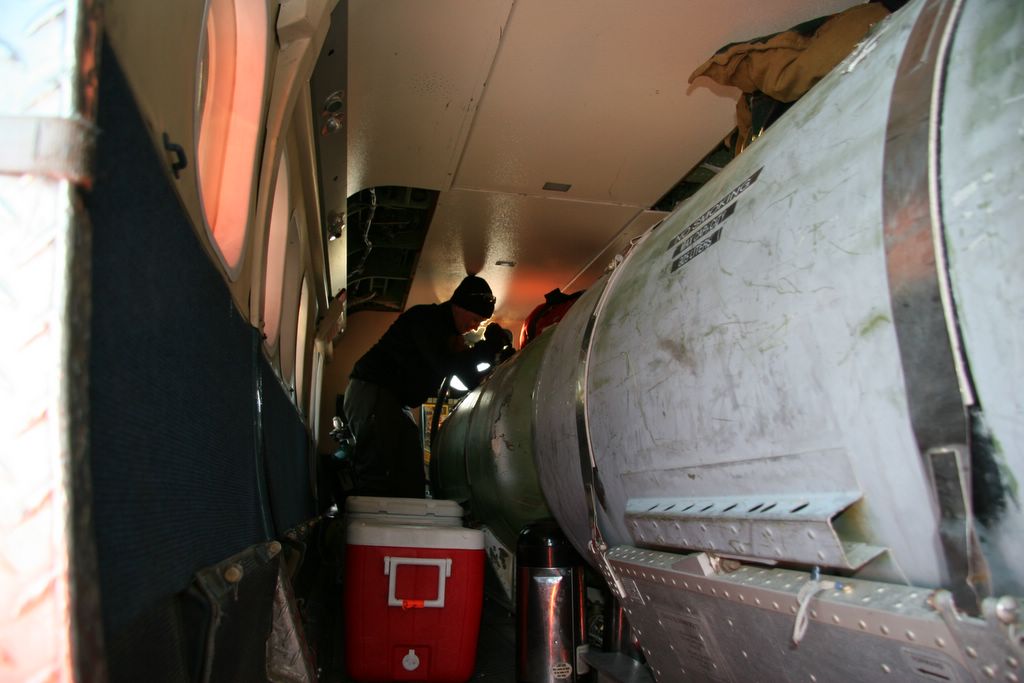
Amy the copilot (who caused quite a stir with some of the men on base) checking the fuel levels in the two massive ferry tanks that they had fitted in the back of the plane.

The plane heading off finally heading off to resue the people on the other plane.
The next day after the twin otter left, despite it being a saturday we spent the whole afternoon drum raising. These drums were 44 gallon (205 litre) drums of Avtur (aviation fuel) which nearly everything down here runs on. They are piled in to heaps of 200ish drums and you have to use the Nodwell crane to hoik them out of the snow. Once they are out of the snow they are dropped onto sledges and flipped upright by hand. Thankfully I didn't have to do too much digging or flipping as I was the designated dozer driver for my shifts.

Raising drums of avtur out of the ground and loading them onto sledges.
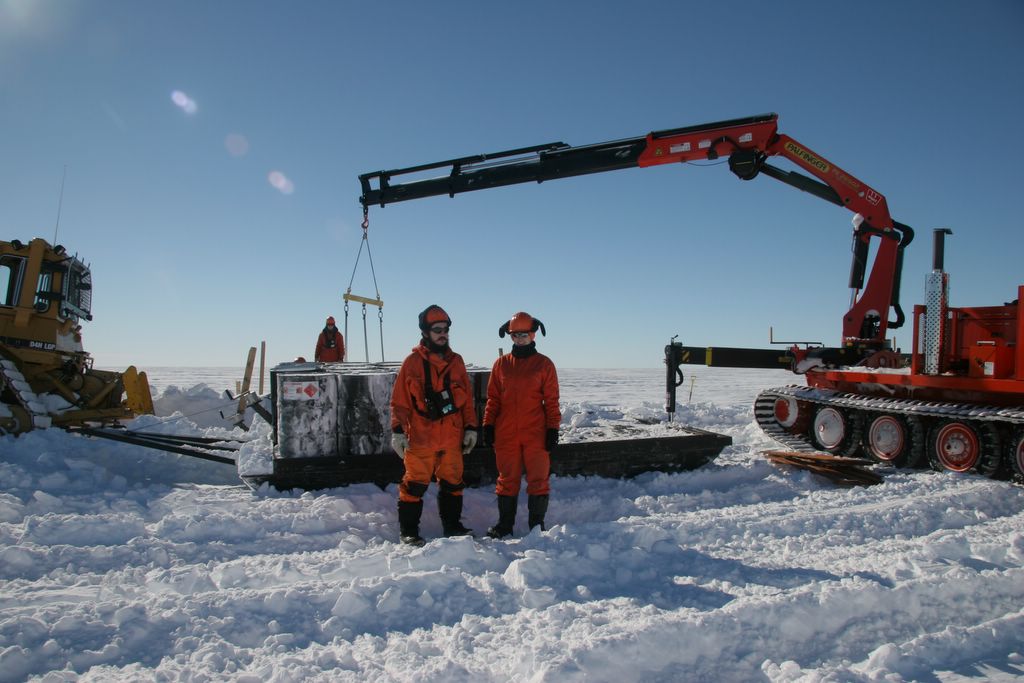
Me and Kirsty just before we did our double shift (I think because Anto thinks I am such a good dozer driver).
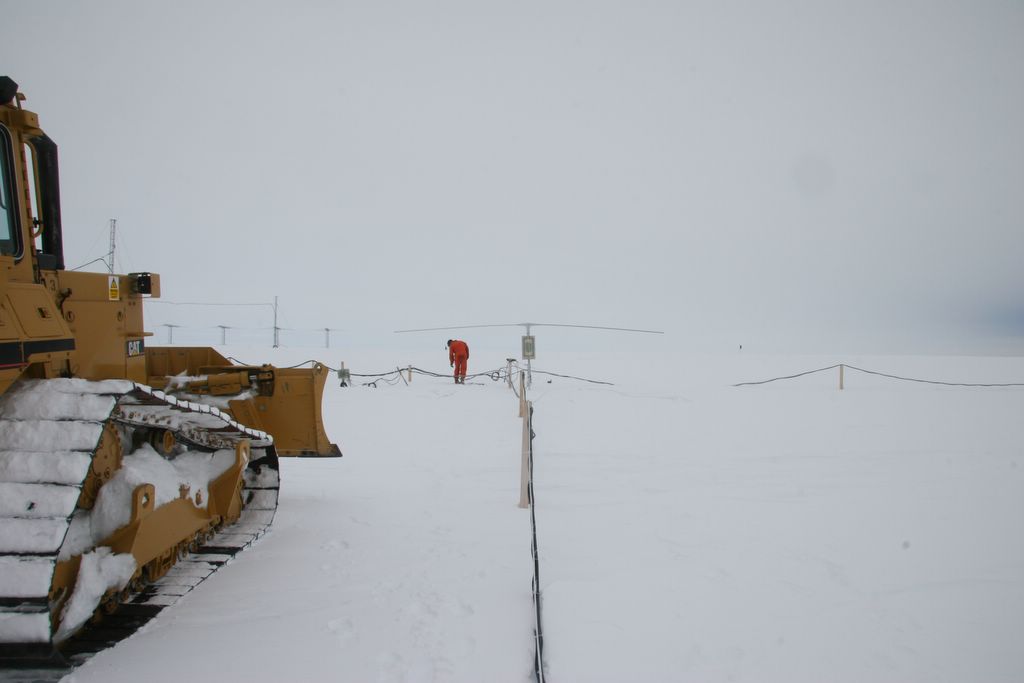
More raising, this time its the AIS receiver antennae. Because of the snow accumulation we had to raise them 2m. As you can see

Once they are lowered to the ground, we checked that they were ok. We attached a new bit of scaffold of then craned them back up and slotted them on.

Me tidying up the cables whilst Liz sets up the theodolite in the background so that the poles are vertical.

Nod 4 with the basket attached. This allows us to lift 250kgs to a height much more than a cherry picker, but relies on the man on the ground to safely move us around.
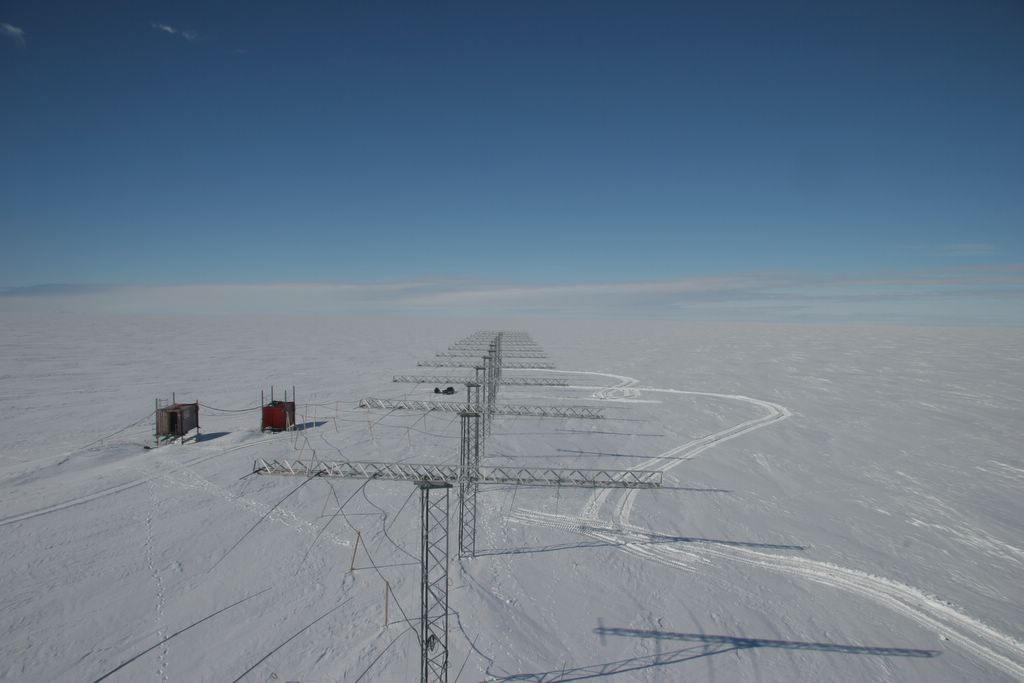
The view of the SHARE array from way above tower number 4. This is from the basket at full extension and being on a flat ice shelf its really odd to look down on anything, especially these antennae.
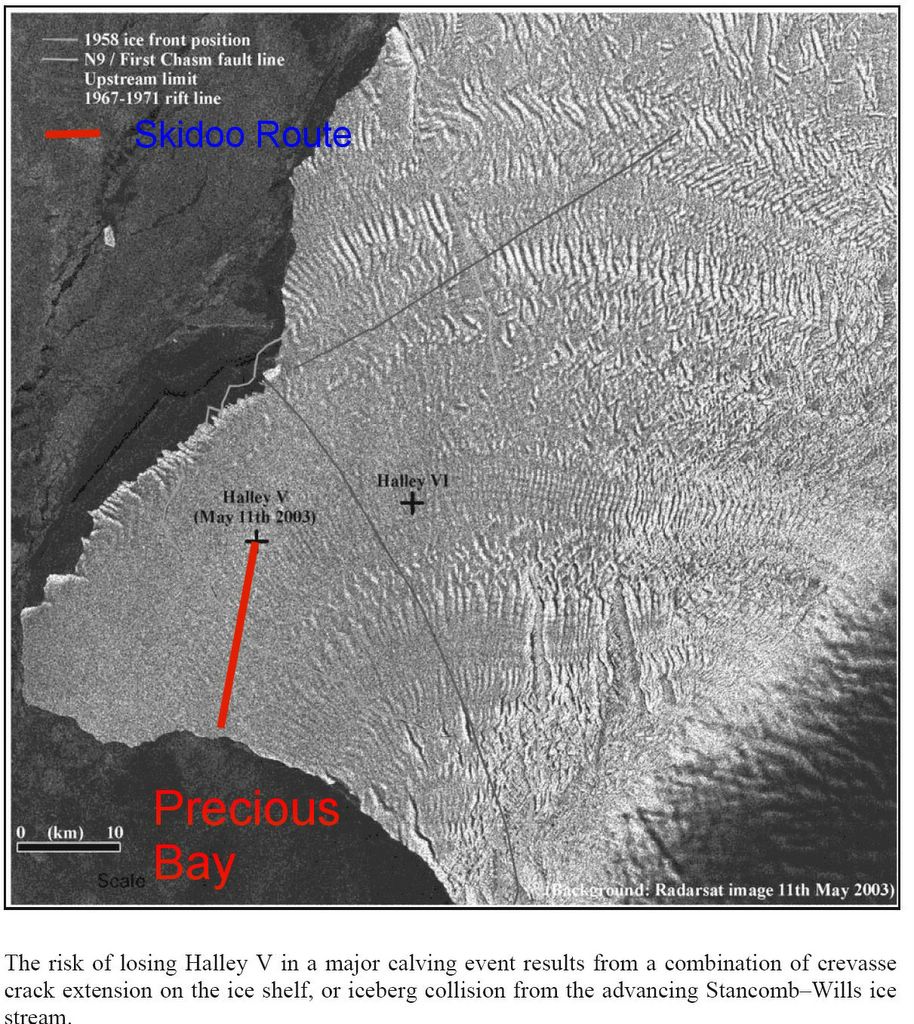
Precious Bay is the bay to the south west of Halley and it is this sea ice that is thought to break up and reform causing ODEs (Ozone Depletion Events). The ODEs trigger sensors and Halley and then the Simpson team launch their Blimp to get a profile of the ozone.

Simon putting on his crampons before our walk down to the ice cliff edge of Precious bay.
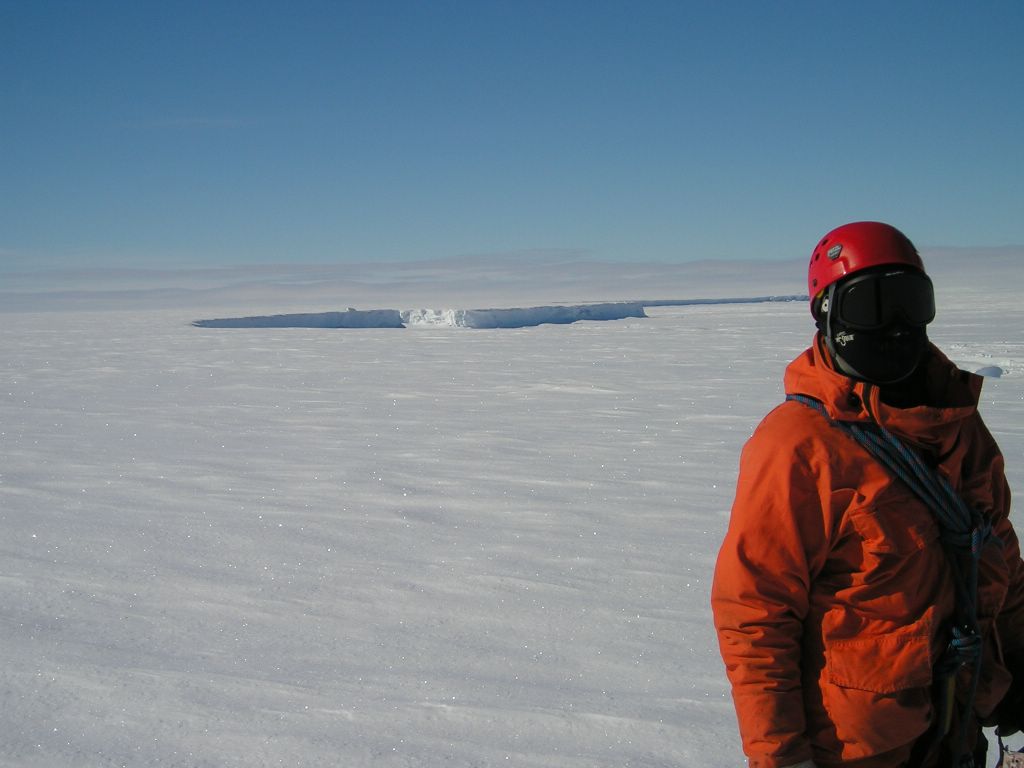
Me near the edge at the bay. Photo courtesy of Simon the GA.
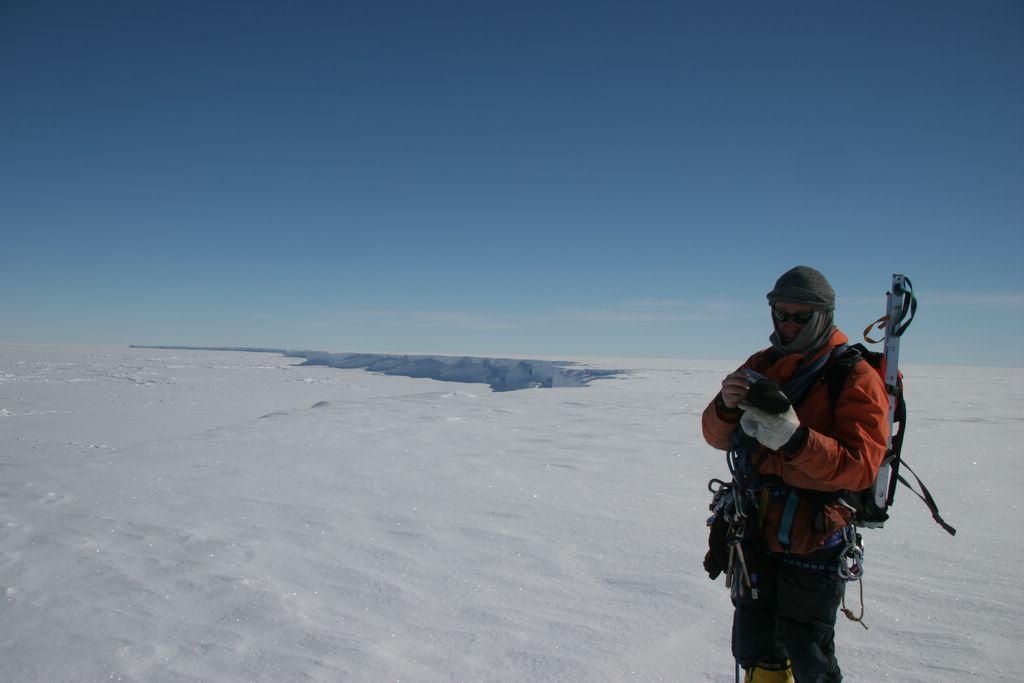
Simon the GA checking out the magnificant view. It was amazingly beautiful with this massive bay and the sea ice stretched out unbroken for miles ahead of us.

Right out on the iceshelf we saw this black dot probably 2km from us and all we could tell was that it was an animal. I put on my big lens (70-300mm) and zoomed in as much as I could. The above picture is cropped and you can make out that it is definetly a seal. So given the state of the ice its probably a Weddell seal (they are the only ones to keep open holes in the ice) but it could have been a leopard seal that had travelled a bit on the ice. From the distance we were away it was just life.
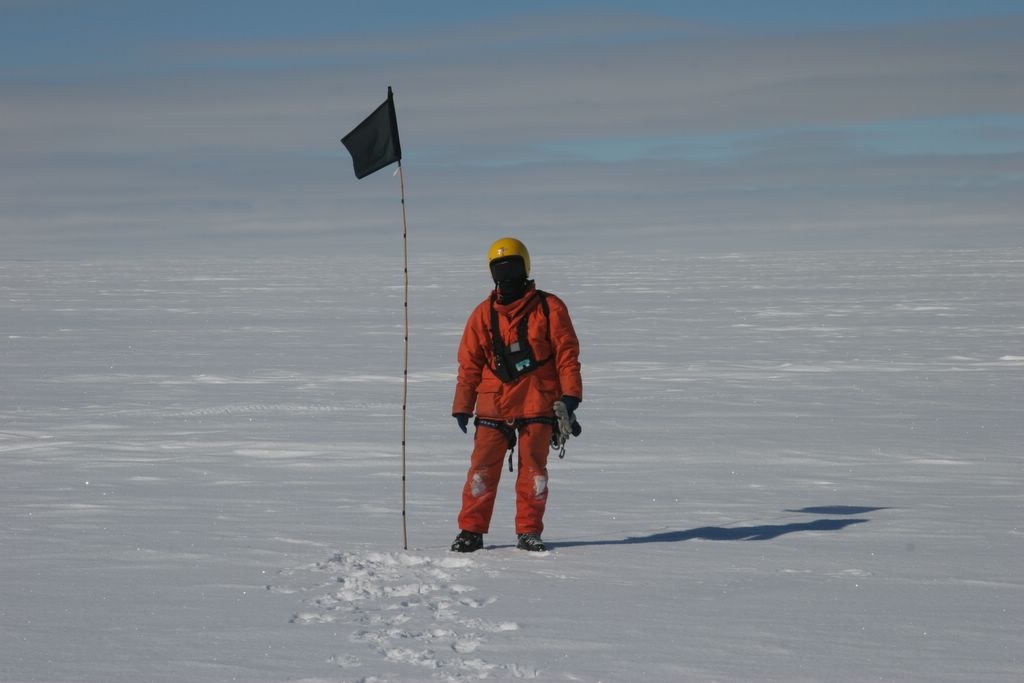
Me next to a marked flag planted at the Precious Bay experiment site that should tell us about snow accumulation.

More raising, this time it was the catenary posts that hold up the wires the antennae. You take of the wires then get a dozer and use the a chain attached to the blade to pull the posts out of the ground.

Chris posing after we had put all the posts back in the ground in their raised positions.
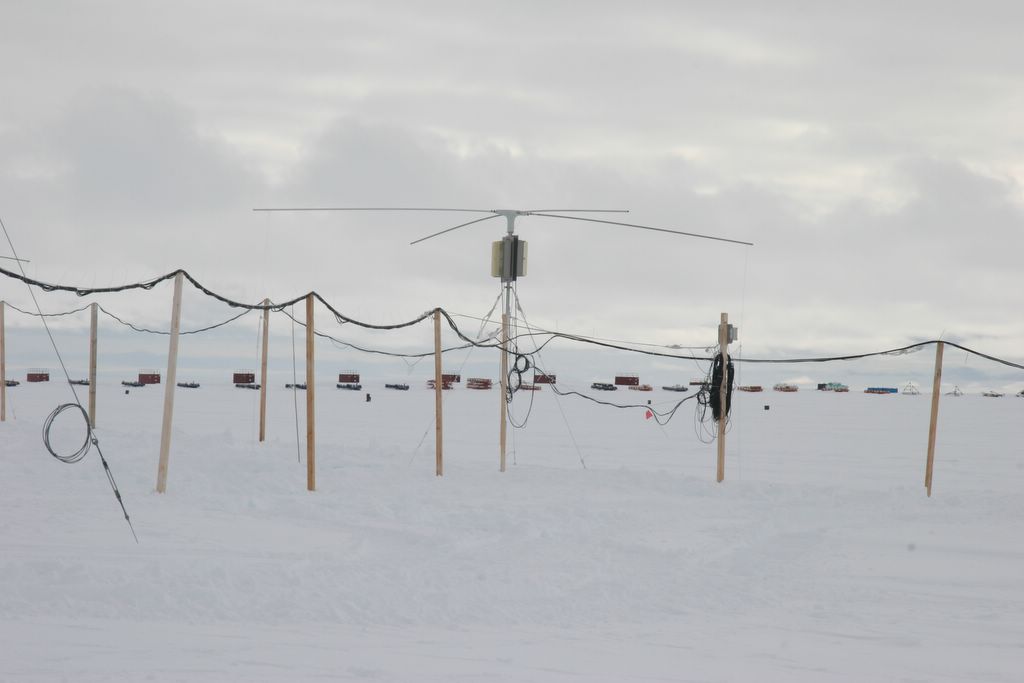
And finally the catenaries are back up.

The Basler again. Its a fantastic plane. You can see the person on the wing (Francis I think) who is holding the fuel pipe that is pumping fuel into the wing tanks.
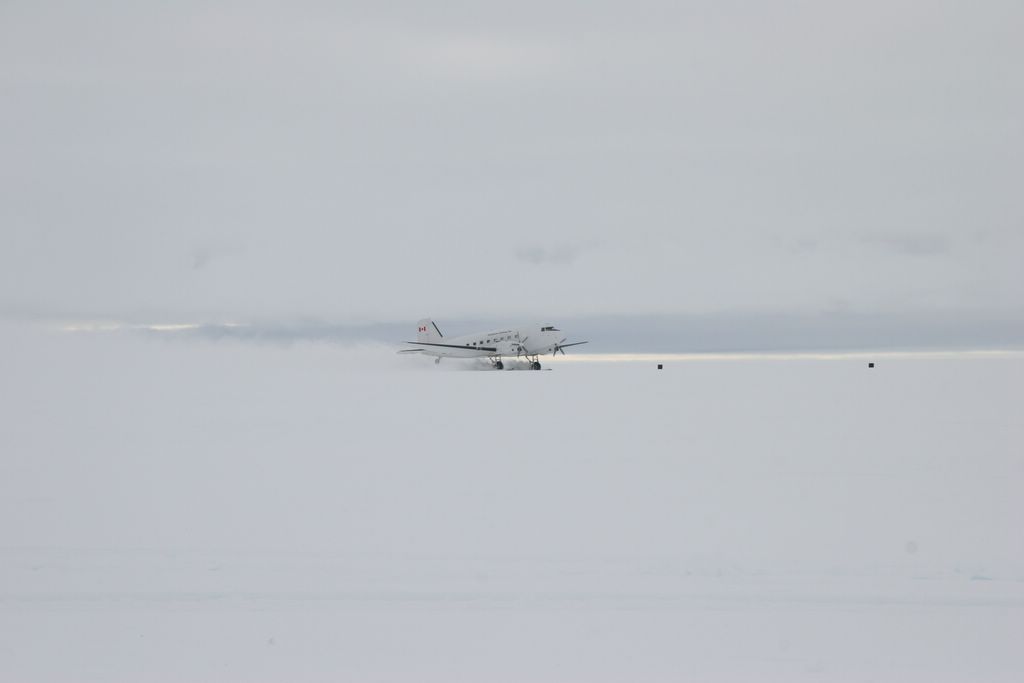
The plane heading off to Novo to move people around and to resue its sister plane nearby.
Subscribe to:
Posts (Atom)